
Short-Term Timer with 2 Light Barriers
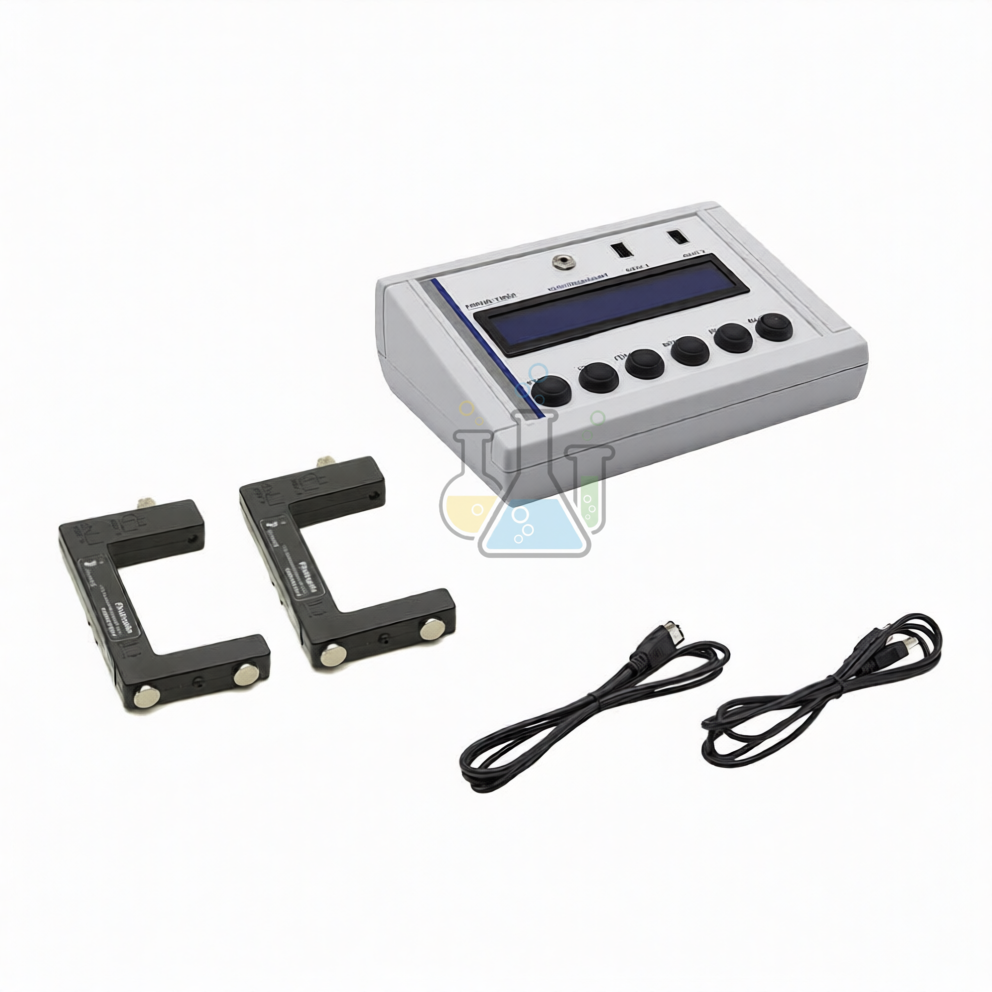
Product Code : SCL-PLE-10517
The Short-Term Timer with 2 Light Barriers from Lab Glassware Manufacturer is a motion-timing apparatus that uses two photogate (light barrier) sensors to measure short time intervals for speed, acceleration, and free-fall experiments. Manufactured and exported from Ambala, Haryana, India since 1982, Lab Glassware Manufacturer supplies this timer set to laboratories across India and to institutional buyers in Morocco, Algeria, Tunisia, and Libya as part of its ongoing supply to the Maghreb region.
Quick answer: This timer set uses two light barriers to precisely measure the time interval as an object passes each sensor, letting students calculate instantaneous speed, average speed, or acceleration in mechanics experiments such as free fall, inclined-plane motion, or collision studies. It is supplied by Lab Glassware Manufacturer as a motion timing apparatus; no certification is claimed unless separately confirmed in writing.
| Specification | Detail |
| Product Name | Short-Term Timer with 2 Light Barriers |
| Brand | Lab Glassware Manufacturer |
| Category | Physics Lab Equipment > Motion Timing Apparatus > Light Barrier Timer Set |
| Number of Light Barriers | 2 |
| Sensor Type | Light barrier / photogate sensor |
| Standards / Certifications | No certification claimed; add only if verified by datasheet, inspection report, or electrical safety document |
| Intended Users | Schools, colleges, physics laboratories, STEM labs, laboratory technicians, distributors, and institutional buyers |
| Indicative Price (India) | Request current indicative market benchmark, incl. GST, for the specific quantity required |
Building a Complete Photogate Timing Setup
A two-light-barrier timer is the core of most mechanics timing experiments, but it typically needs supporting hardware to mount and position the barriers correctly along a track or drop path. Lab Glassware Manufacturer's own Light Barrier Holder, 2 Pieces secures the barriers at the required spacing, while the Fork Light Barrier offers an alternative sensor format for narrower gaps. For free-fall and drop experiments, pairing this timer with an Impact Plate for Time-of-Flight Measurement completes a standard time-of-flight setup. Please confirm the timer's display resolution and triggering mode with Lab Glassware Manufacturer before ordering, as these may vary by configuration.
Frequently Asked Questions
Q: What is the Short-Term Timer with 2 Light Barriers used for?
A: It measures short time intervals using two photogate (light barrier) sensors, used to calculate speed, average speed, or acceleration in mechanics experiments such as free fall or inclined-plane motion.
Q: What type of sensor does this timer use?
A: It uses light barrier (photogate) sensors, which detect an object interrupting a light beam to trigger precise timing.
Q: Does this timer come with mounting hardware for the light barriers?
A: Please confirm with Lab Glassware Manufacturer whether mounting hardware is included, or pair it with a compatible holder such as the Light Barrier Holder, 2 Pieces.
Q: Is a certification provided with this product?
A: No certification is claimed for this product at present. Certification or compliance documentation, such as an electrical safety document, should be requested and verified in writing before ordering.
Related Products
Light Barrier Holder, 2 Pieces | Fork Light Barrier | Impact Plate for Time-of-Flight Measurement
Request a Quote
For current indicative pricing, minimum order quantities, or institutional tender supply of the Short-Term Timer with 2 Light Barriers from Lab Glassware Manufacturer, please contact us or check our lab tender page for ongoing institutional supply opportunities.
Last updated: September 2026
.jpg)
.jpg)
 (1).png)
.jpg)
 (1).png)
 (1).jpg)
.png)