
Conductor Ball
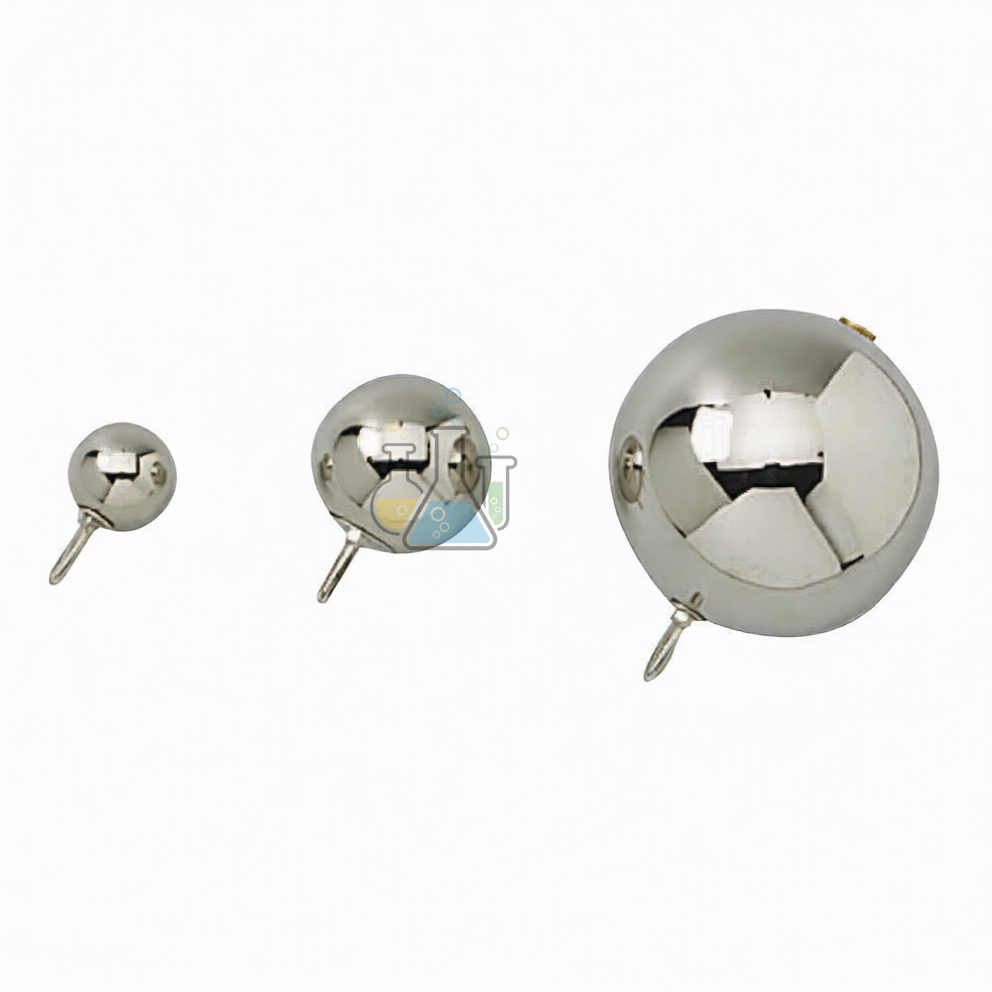
Product Code : SCL-EI-10683
The Conductor Ball 30 mm is a physics laboratory electrostatics accessory manufactured and exported by Lab Glassware Manufacturer, Ambala, Haryana, India, a manufacturer and exporter of laboratory glassware, scientific instruments, and STEM teaching apparatus since 1982. It is a conductive spherical accessory used for demonstrating electrostatics, charge transfer, charge distribution, and induction, and is supplied to schools, colleges, and STEM laboratories across India and to export buyers in countries including South Korea, Japan, Taiwan, and Hong Kong, and across the East Asia region.
Quick answer: The Conductor Ball 30 mm is a simple, reusable conducting sphere used to make electrostatic charge visible and repeatable in the classroom: students can charge it by contact or by induction, then use it with an electroscope, pith ball, or another Lab Glassware Manufacturer electrostatics accessory to observe how charge distributes and transfers. Exact conductive material, mounting stem, and certification status vary by unit — check the specific listing before ordering.
Technical Specifications
| Specification | Detail |
|---|---|
| Product Name | Conductor Ball 30 mm |
| Brand | Lab Glassware Manufacturer |
| Product Category | Physics Lab Equipment / Electronic Instruments / Electrostatics Apparatus |
| Diameter | 30 mm |
| Material | Conductive material |
| Certification | No product-specific certification for this item |
| What May Be Included | 1 Conductor Ball 30 mm, mounting stem/hook/connector or insulated support, instruction sheet — confirm final configuration before ordering |
Applications / Uses
- Demonstrating how charge distributes over a conducting sphere
- Showing charging by contact and charging by induction
- Using with an electroscope to detect transferred charge
- Comparing conductor and insulator behaviour in physics practicals
- Supporting school demonstrations on static electricity and electrostatic force
- Building complete classroom electrostatics experiment sets with other electronic instruments
How to Use the Conductor Ball 30 mm
- Place the conductor ball on a clean, dry, insulated support if the support is supplied or available.
- Discharge the ball before starting by touching it with an approved grounding lead or as instructed by the teacher.
- Bring a charged rod near the ball to demonstrate electrostatic induction, or touch the ball with a charged object to demonstrate conduction.
- Use a pith ball, electroscope, or charge detector to observe the presence and movement of charge.
- Repeat the activity with different charged materials and record the observations.
Safety note: Use this conductor ball only for low-energy classroom electrostatics. Do not connect it to mains electricity or high-voltage equipment unless the apparatus is specifically rated and supervised by a qualified instructor.
Care & Maintenance
- Wipe the ball with a clean, dry, lint-free cloth after use.
- Store it in a dry cabinet to reduce oxidation, dust, and moisture effects.
- Avoid dropping or denting the spherical surface, as deformation can affect demonstration quality.
- Keep it away from corrosive chemicals and wet laboratory areas.
Building a Complete Electrostatics Bench Set
A Conductor Ball is most useful as one accessory in a small electrostatics teaching set, since it needs a charging source and benefits from an instrument that can show or measure the result. Schools can pair it with an Electrostatic Pendulum for a second, independently visible demonstration of the same charge, an Electrostatics Starter Kit for a broader set of induction and charge experiments, and a Coulombmeter to move from a qualitative demonstration to a measured numeric value for the charge involved.
Why Choose Lab Glassware Manufacturer
Lab Glassware Manufacturer designs, manufactures, and exports laboratory glassware, scientific instruments, physics and electronics teaching apparatus, science kits, and STEM models from Ambala, Haryana, India, with a manufacturing history dating to 1982. Its product range covers physics lab equipment, electronic instruments, general lab equipment, and school lab equipment, supplied to schools, colleges, universities, research institutions, and export buyers, including institutional buyers across South Korea, Japan, Taiwan, Hong Kong, and the broader East Asia region. The company holds ISO 9001 and ISO 13485 certification; no item-specific certification is confirmed for the Conductor Ball, and any certification, calibration, or tender-compliance requirement should be confirmed directly with Lab Glassware Manufacturer before order placement.
Frequently Asked Questions
What is a Conductor Ball 30 mm used for?
A Conductor Ball 30 mm is used for electrostatics experiments, especially demonstrations of charge transfer, induction, and charge distribution on a conducting sphere.
What material is the conductor ball made of?
The product is a conductive ball, but the exact metal or alloy should be confirmed before publishing final specifications or issuing a tender quotation.
Is this conductor ball suitable for school physics labs?
Yes. It is suitable for supervised school and college physics practicals involving static electricity and basic electrostatic concepts.
Can it be used with an electroscope?
Yes. It can be used with an electroscope when the mounting and connection arrangement are compatible with the experiment setup.
Does the 30 mm diameter affect the experiment?
Yes. The 30 mm diameter gives a compact demonstration surface suitable for classroom-scale electrostatic activities and bench-top demonstrations.
Is any certification included with this product?
No certification is specified for this product. If certification, calibration, or tender-compliance documents are required, they should be confirmed with Lab Glassware Manufacturer before order placement.
Related Products
Request a Quote
For pricing, specifications, or bulk/institutional orders of the Conductor Ball 30 mm, contact Lab Glassware Manufacturer or submit your requirement via the tender enquiry page.
Last updated: September 2026
 (1).jpg)
 (1).png)
.png)
 (1).png)
.png)
 (1).png)
 (1).png)
.png)